Distress protocol
When someone writes that they are struggling
Kalisme is a wellbeing app, not a medical one, and not an emergency service. If someone writes in it that they are struggling, the app makes no diagnosis and alerts no one: it shows them, straight away, people they can call.
How it works
The person writes.
When they send a message to Kal or save a page of their journal, their phone compares the text with wordings that express a wish to die or to harm themselves, in all 15 languages of the app. This comparison happens on the device.
A notice appears.
It gives the listening line for their country, the youth line where one exists, then the emergency number, under one plain sentence: Kalisme isn’t made for emergencies. Each number can be dialled with a single tap. The numbers follow the country set on the phone, not the language, and have been checked at the source, country by country. Where no number has been checked, the app makes none up: it asks the person to call a listening line or the emergency number.
Your support network, right below.
If you have entered your contacts in the portal (confidential contact person, HR contact, occupational physician, assistance programme), those with a phone number appear below the national lines, never in their place. They are also gathered on the “My organization’s resources” page, opened by a lifebuoy at the top right of the home screen, even offline.
Kal replies, and the notice stays.
Kal is instructed to point towards human help. When its reply to a message of distress goes through our server without the checked number, the server adds it before the reply appears. The notice appears before any quota check: it depends neither on a subscription nor on the number of messages left. Once triggered, it comes back for 24 hours whenever the person reopens Kal.
What the person sees
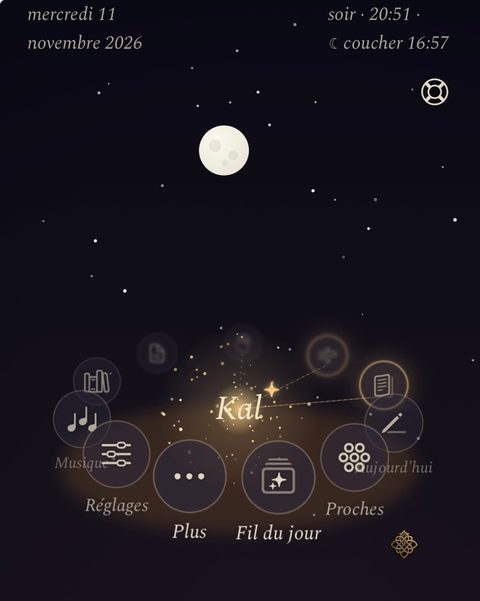
The lifebuoy appears at the top right of the home screen once your organization has entered its contacts. 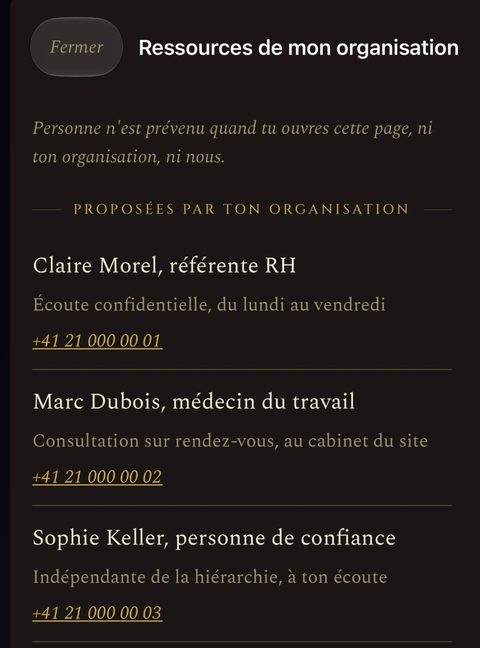
“My organization’s resources”: your contacts, then the country’s emergency numbers. 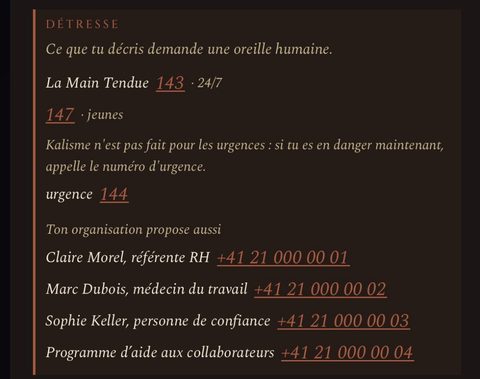
The notice in Kal: the listening line, the emergency number, then your support network.


Screenshots of the app in French, on a sample organization, with fictitious numbers. Tap an image to enlarge it.
What is never reported
The app sends no alert, to anyone: not to your organization, not to Kalisme, not to a relative, not to emergency services. The app keeps no record of the notice being shown, and opening the resources page notifies no one. Your portal shows nothing of it: neither who saw it nor how often.
This is a choice. A tool paid for by the employer that reported the distress of a named person would become a surveillance tool, and no one would write in it any more. The cost is real: no one knows that someone is struggling, and it is up to them to dial the number.
What they write in their journal stays on their phone. What they write to Kal follows the route described in our data processing agreement.
Its limits, stated plainly
- It is a search for wordings, not an assessment. It can miss distress expressed in other words, and appear for a sentence that was nothing of the kind.
- Kalisme makes no diagnosis and is neither a medical device, nor an emergency service, nor a human listening service: no one at Kalisme reads the conversations.
- It replaces neither your support network nor your occupational health service. It points people towards them.
A Kalisme initiative
This protocol is a Kalisme initiative, designed with rigour and described here exactly as the app applies it. To date, no external body has reviewed or validated it, despite our many requests. We would rather tell you: judge it by what it does.